
Most people picture house flipping as a months-long grind of gutted kitchens, contractor headaches, and six-figure renovation budgets. Micro flipping throws that entire picture out. This strategy is built around buying undervalued properties and reselling them quickly with little to no rehab, relying on data and speed rather than a sledgehammer. If you are a real estate investor looking for faster capital turns and lower exposure in a market that has made traditional real estate flipping increasingly painful, micro flipping deserves your full attention.
Table of Contents
- Key takeaways
- What micro flipping actually is
- The 2026 market and what it means for flippers
- How to micro flip homes: a practical framework
- Common mistakes that kill micro flip profits
- Tips to scale your micro flipping business
- My honest take on micro flipping right now
- Find better micro flip deals with Wholesalehq
- FAQ
Key takeaways
| Point | Details |
|---|---|
| Speed over renovation | Micro flipping prioritizes fast resale with minimal rehab, cutting timelines from months to weeks. |
| Data drives deals | Profitable micro flips depend on accurate ARV and MAO calculations, not gut instinct. |
| Market selection matters | Affordable metros like Peoria and Huntington are outperforming high-cost markets for flip margins. |
| Discipline protects profits | Overpaying or over-improving a property is the fastest way to erase your margin. |
| Technology is a force multiplier | Platforms that score leads and analyze competition give investors a measurable edge in deal velocity. |
What micro flipping actually is
Micro flipping is a property investment flipping strategy where you acquire a home at a discount and resell it quickly, typically within days to a few weeks, with minimal or zero renovation. The core model is simple: find a motivated seller, buy below market value, and flip the contract or the deed to another buyer before carrying costs eat your profit.
What separates micro flipping from traditional house flipping strategies is the absence of a major rehab phase. Traditional fix-and-flip investors budget for full kitchen remodels, roof replacements, and HVAC overhauls. Micro flippers skip most of that. Their edge comes from data, not drywall.
Here is a direct comparison so you can see the difference clearly:
| Factor | Traditional fix-and-flip | Micro flipping |
|---|---|---|
| Timeline | 3 to 12 months | Days to 6 weeks |
| Renovation scope | Major to full rehab | Minimal or none |
| Capital required | High ($50K to $150K+) | Low to moderate |
| Risk level | Higher (cost overruns, market shifts) | Lower (shorter exposure window) |
| Deal sourcing | MLS, agents, auctions | Data platforms, off-market leads |
| Profit per deal | Higher potential | Lower per deal, higher volume |
The technology angle is what makes modern micro flipping viable at scale. Investors use data platforms to score motivated sellers, analyze cash transaction density, and calculate maximum allowable offer (MAO) before ever visiting a property. Effective micro flipping requires fast deal velocity enabled by digital data tools and efficient financing partners. Without that infrastructure, you are just guessing.
Typical ROI per micro flip is lower than a full renovation project, but the volume potential and reduced capital exposure make it attractive for investors who want to recycle cash quickly rather than park it in a six-month rehab.
The 2026 market and what it means for flippers
The broader flipping market is under real pressure right now. Single-family homes flipped dropped to 297,045 in 2025, the lowest count since 2020, with gross ROI hitting 25.5%, the lowest since 2008. That context matters because it tells you the old playbook is not working as well.
Higher home prices and elevated interest rates have compressed margins for traditional flippers. The investors still making money are the ones who adapted. Buyer preferences in 2026 have shifted toward fixer-uppers over fully renovated flips, partly because buyers cannot afford to pay the premium a full rehab commands. That is actually good news for micro flippers. You do not need to deliver a magazine-ready kitchen to move a property.

The geographic story is equally important. Profit margins have fallen in 70% of metro areas, but affordable markets like Peoria, Illinois and Huntington, West Virginia showed significant ROI gains. The lesson is clear: chasing deals in expensive coastal markets is a losing game for micro flippers. Affordable secondary markets with motivated sellers and lower competition are where the real opportunity sits.
| Market type | 2026 margin trend | Micro flip suitability |
|---|---|---|
| High-cost coastal metros | Declining | Low |
| Mid-tier suburban markets | Mixed | Moderate |
| Affordable secondary cities | Improving | High |
Pro Tip: Before committing to a market, check the median days on market and the ratio of cash sales to total sales. High cash transaction density signals active investor activity and faster resale potential, both critical for micro flipping success.
Disciplined buying is non-negotiable in this environment. Successful flippers focus strictly on buying deals with clear margin. Optimistic assumptions about ARV or renovation costs are where most investors lose money.
How to micro flip homes: a practical framework
Learning how to micro flip homes comes down to executing five phases consistently and without shortcuts.
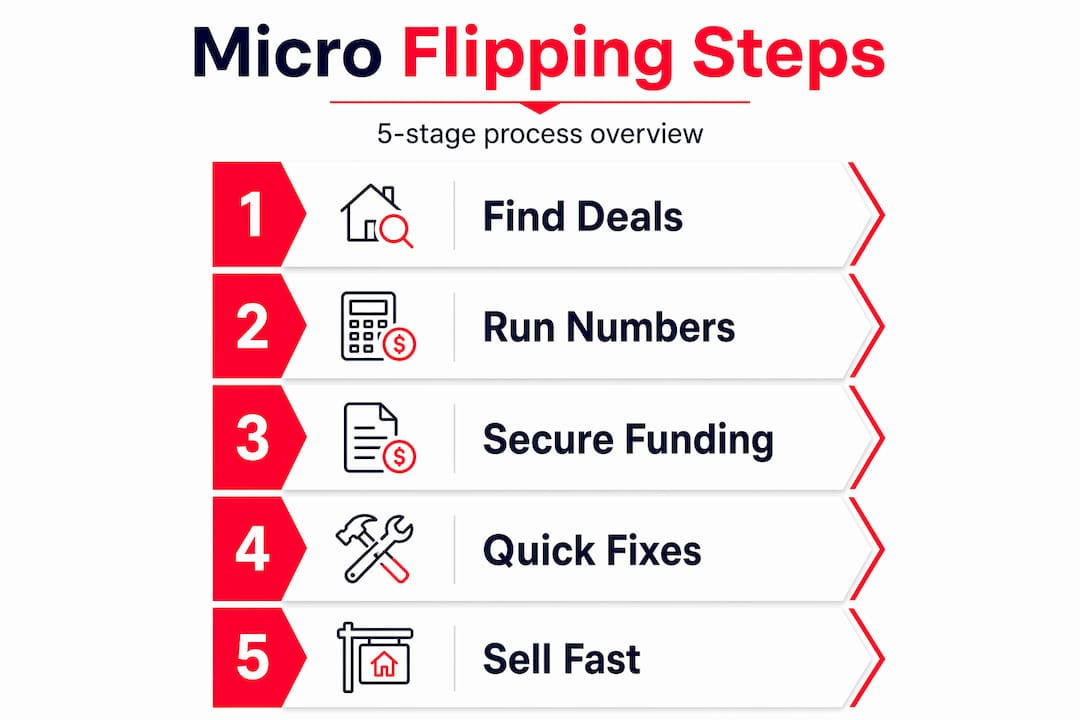
1. Find off-market deals with data
The MLS is too competitive for micro flipping. You need motivated sellers before they list. Use data platforms that score leads by seller motivation, equity position, and days since last sale. Networking with probate attorneys, divorce attorneys, and property managers also surfaces deals that never hit the open market.
2. Run your numbers before anything else
Every deal starts with ARV and MAO. The 70% rule is the standard framework: your maximum purchase price should be no more than 70% of ARV minus estimated repair costs. Experienced flippers recommend a 20% renovation contingency fund on top of your repair estimate to buffer unexpected costs. If the deal does not pencil at those numbers, walk away.
3. Secure financing fast
Speed is your competitive advantage, and slow financing kills deals. Hard money loans cover 80 to 90% of purchase and 100% of renovation costs, with rates between 10 and 14% and 12-month terms. They are expensive, but they close in days, not weeks. Build relationships with two or three hard money lenders before you need them.
4. Keep renovations surgical
Micro flipping is not about zero improvements. It is about the right improvements. Paint upgrades yield over 200% ROI, kitchens return 100 to 150%, and bathrooms come in at 90 to 120%. Focus your dollars on paint, curb appeal, and cleaning. Avoid structural work, custom finishes, or anything that adds weeks to your timeline.
Pro Tip: Do a detailed walkthrough before listing to eliminate minor defects like loose fixtures, scuffed trim, and sticky doors. This "punch-out" phase prevents price reductions during negotiation and protects your margin.
5. Sell fast and strategically
Listing homes on Thursday or Friday maximizes weekend showings and accelerates the sale timeline. Price aggressively from day one. A property sitting on the market for 60 days is not a micro flip. It is a carrying cost problem.
If the property does not sell within your target window, have a backup plan. A rental contingency plan covers holding costs if the market stalls and protects you from a forced sale at a loss.
Common mistakes that kill micro flip profits
Most failed micro flips trace back to one of these errors. Recognizing them before they happen is the difference between a profitable portfolio and an expensive education.
- Overpaying at acquisition. No renovation strategy rescues a deal where you paid too much. The profit is made at purchase, not at sale.
- Renovating to personal taste. Buyers in your target market do not care about your design preferences. Over-improving properties beyond neighborhood standards creates a price ceiling that caps your upside.
- Underestimating holding costs. Property taxes, insurance, utilities, and loan interest add up fast. A deal that looks profitable on paper can turn negative after 90 days of carrying costs.
- No exit strategy beyond the flip. If your only plan is to sell retail and the market softens, you are exposed. Always know your backup options before you close.
- Skipping pre-sale inspections. Buyers who discover issues during their own inspection will renegotiate or walk. A pre-sale inspection lets you control the narrative and price accordingly.
- Ignoring financing fees in deal math. Hard money rates of 10 to 14% are a real cost. Model them into your MAO calculation from the start, not as an afterthought.
Tips to scale your micro flipping business
Once you have executed a few deals successfully, the goal shifts from learning the process to repeating it faster and with better margins.
Leverage technology at every stage. Platforms that combine seller motivation scoring, cash transaction analysis, and competitor density data let you filter hundreds of potential deals down to the handful worth pursuing. That kind of deal velocity is impossible with manual research. Profitability comes from buying the right deals, not from expensive renovations. Technology helps you find those deals faster than your competition.
Build your buyer list before you need it. Cash buyers who move quickly are worth more than retail buyers who take 45 days to close. Attend local real estate investment meetups, connect with wholesalers, and maintain a running list of buyers who have closed with you or expressed interest in your market.
Scaling also means protecting your criteria. The temptation when deal flow is slow is to stretch your numbers and rationalize a marginal deal. Disciplined investors who control renovation scope and timing consistently outperform those who chase volume at the expense of margins. Set your MAO floor and do not move it.
Pro Tip: Consider forming equity partnerships with other investors to fund deals you cannot finance alone. Splitting a 20% return with a capital partner beats passing on a solid deal entirely.
Finally, track your metrics obsessively. Days to close, renovation cost variance, days on market, and actual versus projected ROI should be reviewed after every deal. The investors who scale fastest are the ones who treat each flip as a data point, not just a transaction.
My honest take on micro flipping right now
I have watched a lot of investors chase the wrong version of house flipping. They see the TV shows, budget for a full gut renovation, and then get crushed by cost overruns and a market that moved while they were mid-project.
What I have learned is that micro flipping works precisely because it does not try to manufacture value through renovation. It finds value that already exists and moves it to a buyer who wants it. That is a fundamentally different skill set, and in my experience, it is one that rewards analytical thinkers more than construction managers.
The biggest misconception I see is that micro flipping is just wholesaling with a different name. It is not. Wholesaling assigns contracts. Micro flipping closes on the property, makes targeted improvements, and resells. The distinction matters because your profit ceiling is higher and your buyer pool is wider.
My honest advice: start in a market you can analyze deeply before you can analyze broadly. Pick one affordable metro, learn the comps cold, build your lender and buyer relationships, and run your first three deals conservatively. The speed and confidence come with repetition, not with ambition.
— Zach
Find better micro flip deals with Wholesalehq
The hardest part of micro flipping is not the renovation or the financing. It is finding the right deals before your competition does.

Wholesalehq is built specifically for investors who need an edge in deal sourcing. The platform combines seller motivation scoring, cash transaction density analysis, and competitor presence data to surface leads in markets where you can actually win. You get pre-calculated MAO and ARV figures so you can evaluate a deal in minutes, not hours. For investors serious about scaling their flip strategy, Wholesalehq removes the guesswork from market selection and puts data-driven deal flow directly in your hands. Stop sifting through saturated markets and start working the ones where margins still exist.
FAQ
What is micro flipping in real estate?
Micro flipping is a property investment strategy where an investor buys a home below market value and resells it quickly, typically within days to a few weeks, with minimal or no renovation. The model relies on data-driven deal sourcing and fast execution rather than value-add through major rehab.
How is micro flipping different from wholesaling?
Wholesaling assigns a purchase contract to another buyer without the investor ever taking title. Micro flipping involves actually closing on the property, making light improvements if needed, and then reselling it, which means a higher potential profit margin and a broader pool of end buyers.
What is the 70% rule in micro flipping?
The 70% rule states that your maximum purchase price should be no more than 70% of the property's after-repair value (ARV) minus your estimated repair costs. This calculation protects your margin and accounts for financing, holding, and selling costs.
Which markets are best for micro flipping in 2026?
Affordable secondary markets are outperforming high-cost metros. Markets like Peoria and Huntington have shown ROI gains while margins have fallen in 70% of metro areas nationally, making lower-priced markets with motivated sellers the strongest targets for micro flipping right now.
What financing works best for micro flipping?
Hard money loans are the most common choice because they close fast and cover a large portion of acquisition and renovation costs. Rates run 10 to 14% with 12-month terms, so you need to model that cost into your deal analysis from the start to protect your profit.